Safe Vision: Real-Time Assault Detection with Blockchain Evidence
How Safe Vision combines a real-time computer vision model with blockchain-backed evidence storage to flag suspicious activity from live video.
Sample post. This write-up documents Safe Vision, a real project listed on this portfolio, formatted as a case study. Swap in more detail from the actual build whenever you want to expand it.
01Overview
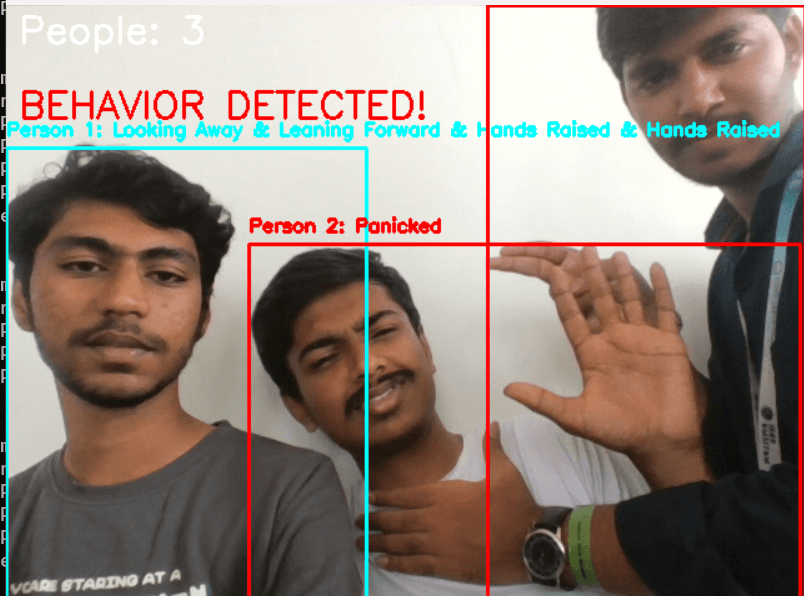
Safe Vision is a real-time surveillance system that watches a live video feed, flags suspicious or violent behavior as it happens, and writes tamper-evident records of what it detected to a blockchain-backed log.
02Problem
Traditional CCTV is reactive — footage gets reviewed after something has already gone wrong, and evidence chains of custody are easy to dispute. The goal was a system that could flag an incident the moment it happens and produce a record nobody could quietly alter afterward.
03Goals
- Detect assault-type behavior from live video with high accuracy
- Keep detection latency low enough to be genuinely "real-time"
- Store flagged evidence in a way that's provably tamper-proof
04Technologies
Python · OpenCV · YOLO · Blockchain
05Architecture
A video ingestion pipeline feeds frames into a detection model trained to recognize assault-like motion patterns. When the model's confidence crosses a threshold, the system captures the relevant frames and pushes a hash of that evidence to a blockchain ledger, so the existence and content of the flagged event can be verified independently of the system that generated it.
06Development
The detection side is built around a YOLO-based model tuned for the target behavior classes, running over frames pulled from the live feed with OpenCV. The evidence side is a lightweight blockchain integration that anchors a hash of each flagged clip rather than storing full video on-chain, keeping the chain itself lightweight while still making tampering detectable.
07Challenges
Real-time video inference is unforgiving of anything slow — every extra millisecond per frame compounds. Getting detection accuracy high while keeping inference fast enough for a live feed meant iterating on both model size and the surrounding pipeline.
08Solutions
The model currently reaches 92% detection accuracy while staying within a live-feed latency budget, by keeping the inference model appropriately sized for the task rather than reaching for the largest available architecture.
09Results
92% detection accuracy on the target behavior classes, with evidence write-through to the blockchain layer for verifiable incident logging.
10Lessons Learned
Pairing a real-time model with a trust layer (the blockchain evidence trail) turned out to be as much a systems problem as a machine learning one — the interesting engineering was in getting the two halves to hand off cleanly under real-time constraints.
11GitHub
The project repository is available on GitHub.
Related Articles
 Projects
SongSense: A Music Genre Classifier from Audio Signals
How SongSense uses audio signal processing and spectral analysis to classify music genre, and where it landed on accuracy.
Aug 15, 2026 · 2 min readRead Learning
Getting Started with OpenCV for Real-Time Video Analysis
A practical introduction to OpenCV — reading a video stream, running basic frame processing, and the patterns I reuse across every computer vision project.
Aug 5, 2026 · 2 min readRead Projects
Krishi Sakhi: A Malayalam-Voice AI Farming Assistant
Building an AI assistant that farmers can talk to in Malayalam, and why speech recognition accuracy mattered more than model size.
Jul 28, 2026 · 2 min readRead